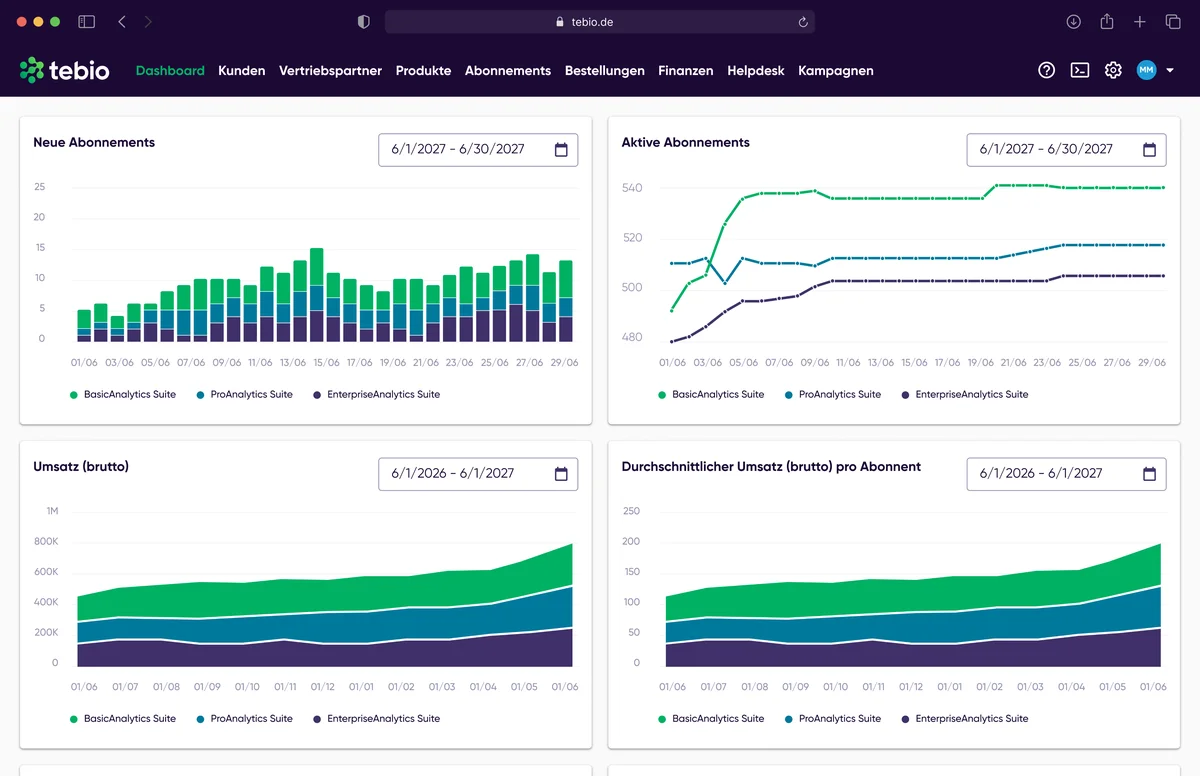











1. Book a new mobile plan
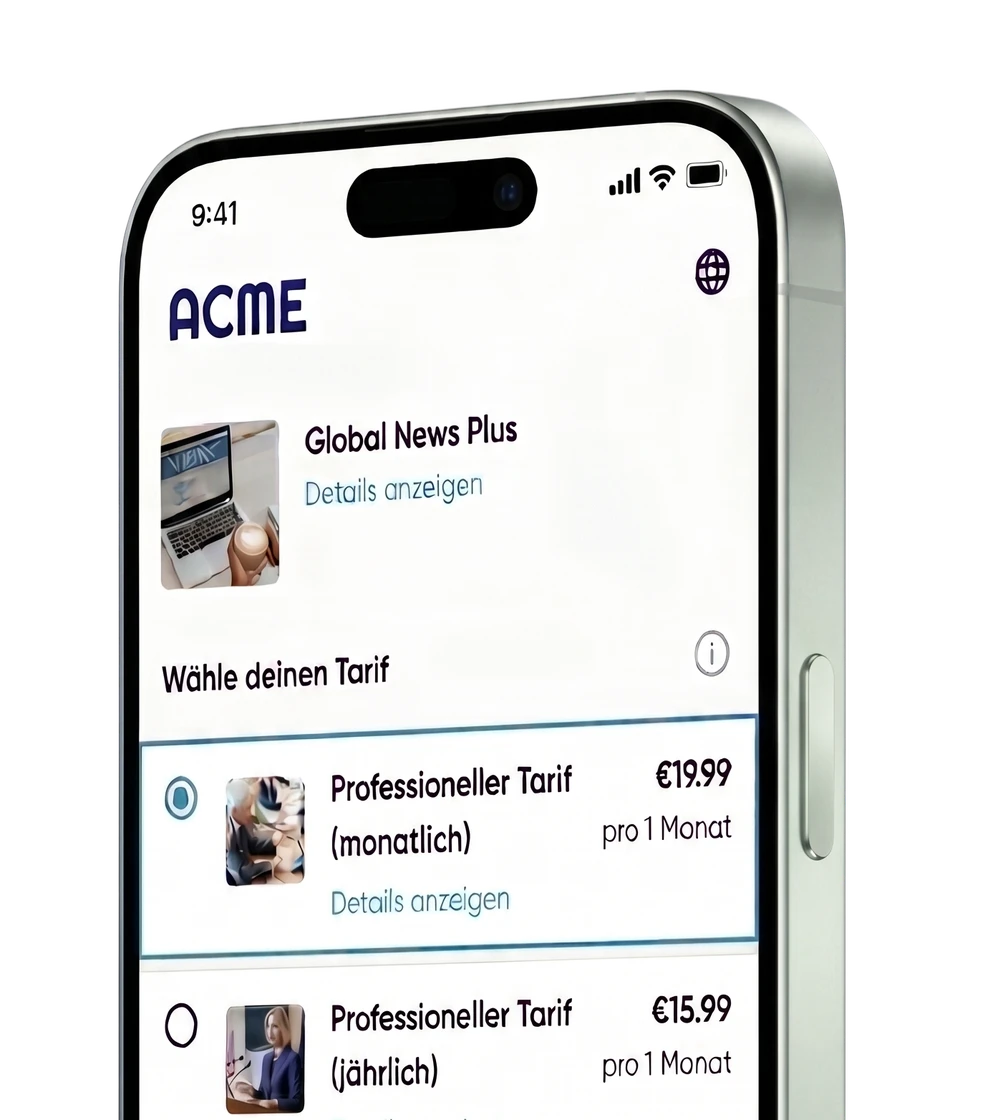
Customers can order plans via Hosted Pages, an existing frontend or through internal teams in the Business Portal. tebio brings customer data, subscription, product, payment method and billing together in one process.
For MVNOs, mobile service providers and telco-as-a-service models
Sell, manage and automatically bill mobile plans — with the Business Portal, Hosted Pages, API and Webhooks. tebio is the BSS and commercial layer for plans, customers, subscriptions, usage, billing, payments and Self-Care. For broader telco-as-a-service scenarios the solution can be integrated with provisioning, real-time charging, policy control, voice services and existing hosting networks.
 Order / Hosted Page
 Subscription / plan
 Customer
 SIM, eSIM or resource
 Usage / Rating
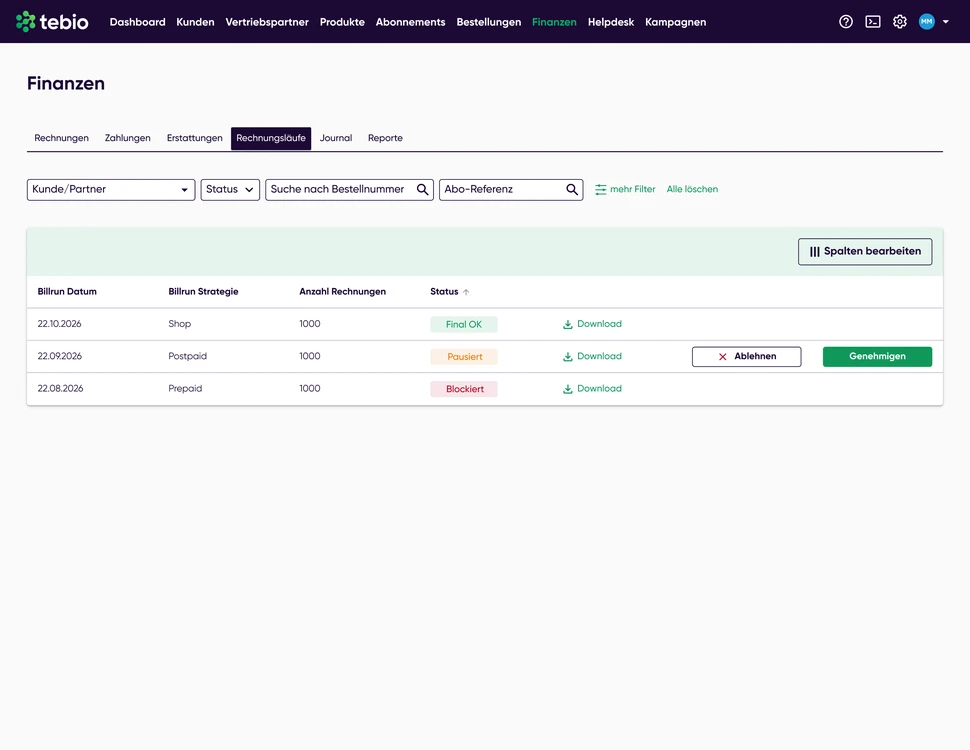
 Billrun
 Invoice / payment
 Webhooks / Provisioning / Finance






Mobile service providers need to keep customers, plans, options, SIM or eSIM resources, usage data, included allowances, add-on packages, invoices, payments and support processes reliably in sync. At the same time, external telco systems, Self-Care portals, finance processes and customer communication must work together.
 Customers book plans, options and add-on packages through different channels.Prepaid and postpaid models have different billing logic.Usage must be rated and assigned to the right plan, package or pool.Included data, minutes, SMS or data packages must be processed traceably.Exceeding usage must be billed correctly.SIM, eSIM or resource status must stay in sync with external systems.Failed payments affect customer service and downstream processes.Support, Self-Care and technical provisioning must work together.
With tebio, you manage customers, subscriptions, products, options, prices, discounts, usage events, invoices, payments and downstream processes in one platform. Via the Business Portal, Hosted Pages, API and Webhooks, tebio can be integrated into existing telco, provisioning, CRM, Finance and Self-Care processes.
tebio is the BSS and commercial layer. Network-side functions such as real-time charging, policy control, voice switching or value added services can be integrated as additional service components, depending on the telco project and the interfaces exposed by the hosting network.
Telco-as-a-service connects commercial BSS processes with network-facing service functions and the existing hosting-network infrastructure. Depending on the business model and network environment, tebio can be combined as the central BSS layer with additional telco service components.


Optional / project-specific
Which service functions and interfaces can be used depends on the technical capabilities of the respective hosting network and the project-specific scope of integration.
Customers can order plans via Hosted Pages, an existing frontend or through internal teams in the Business Portal. tebio brings customer data, subscription, product, payment method and billing together in one process.
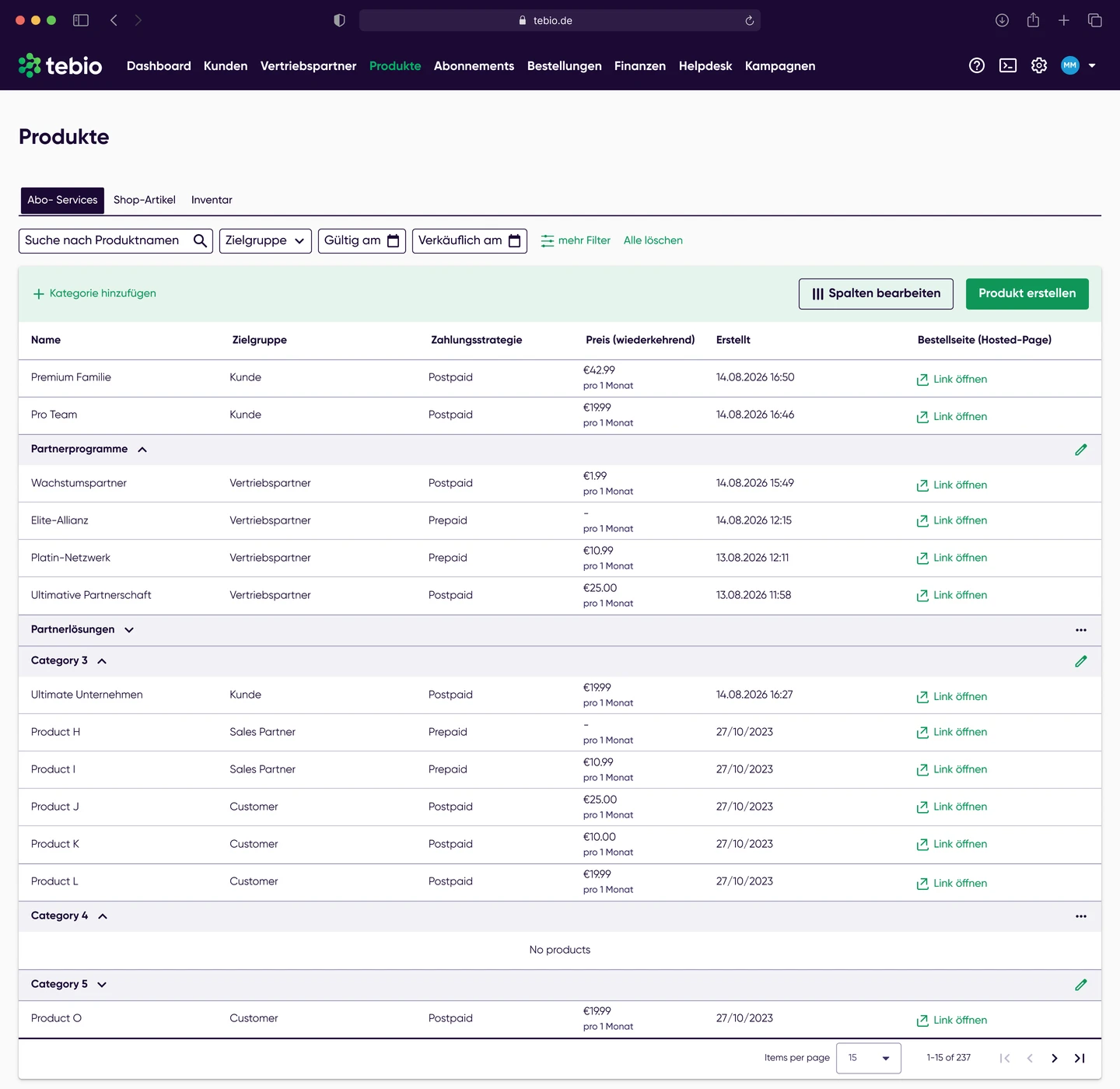
Mobile offerings can be modeled using products, options, prices and discounts — for example base plans, data packages, add-on options or time-limited offer logic.
tebio supports prepaid and postpaid business models at subscription and billing level. For scenarios with network-side real-time authorization, balance management, usage limits or spending control, the solution can additionally be integrated with an online charging system.
Usage events can be passed to tebio, rated and processed in billing. This lets you account for consumed units, included allowances and additional usage in billing. Real-time control during an active network session is separate and can be handled via a connected online charging or policy control layer.
Mobile plans can include data allowances or shared allowances. If an allowance is exceeded, additional usage can flow into billing as exceeding usage.
Information on plans, subscription status, booked options or resources can be exchanged with external provisioning, SIM/eSIM or telco systems via API and Webhooks. Depending on the target architecture, activation/provisioning processes as well as resource and inventory data can also be synchronized with the hosting network or other technical platforms.
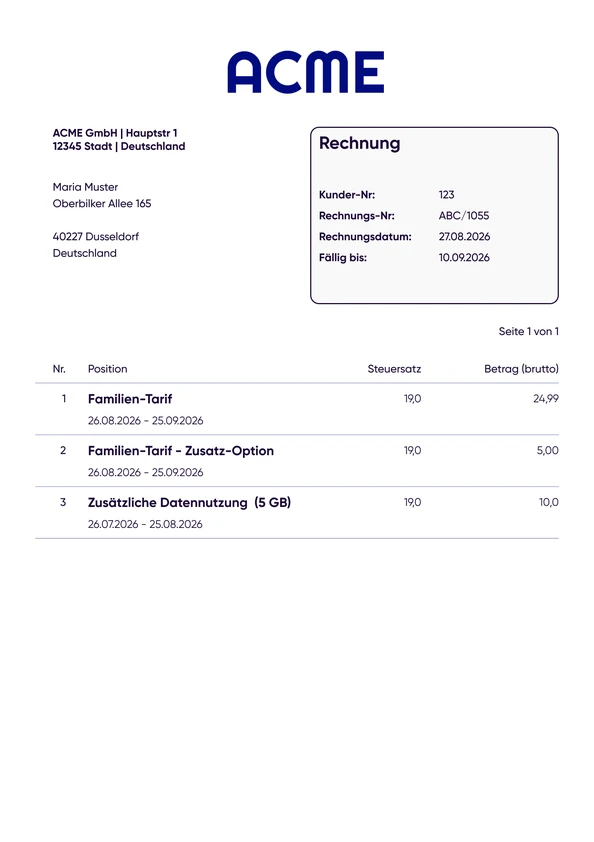
Recurring fees, usage-based line items, discounts, prorated charges, invoices and payment processes can be processed based on rules.
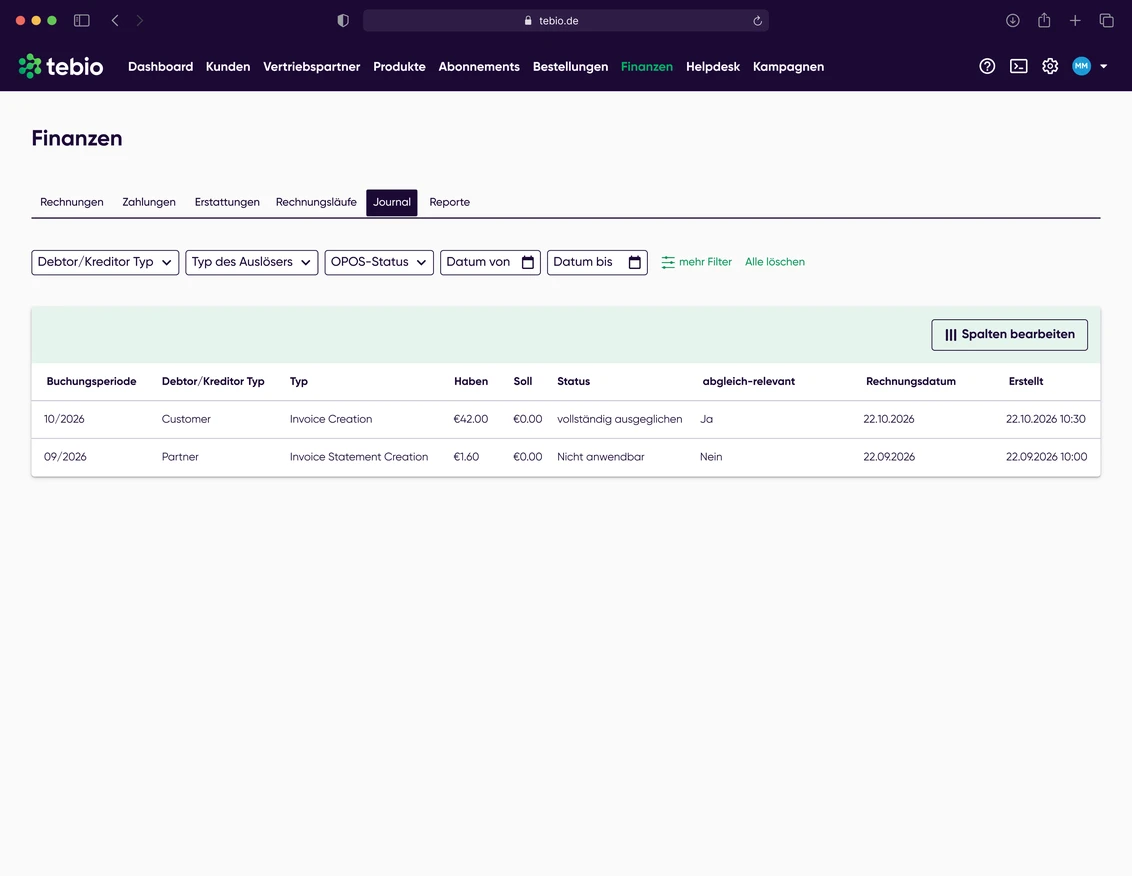
Failed SEPA direct debits, open invoices or missing bank transfers can be tracked in the Business Portal and handed over to customer service or Finance processes.
Self-Care and integrated helpdesk processes support customer requests about plans, invoices, payments, options or contract changes.
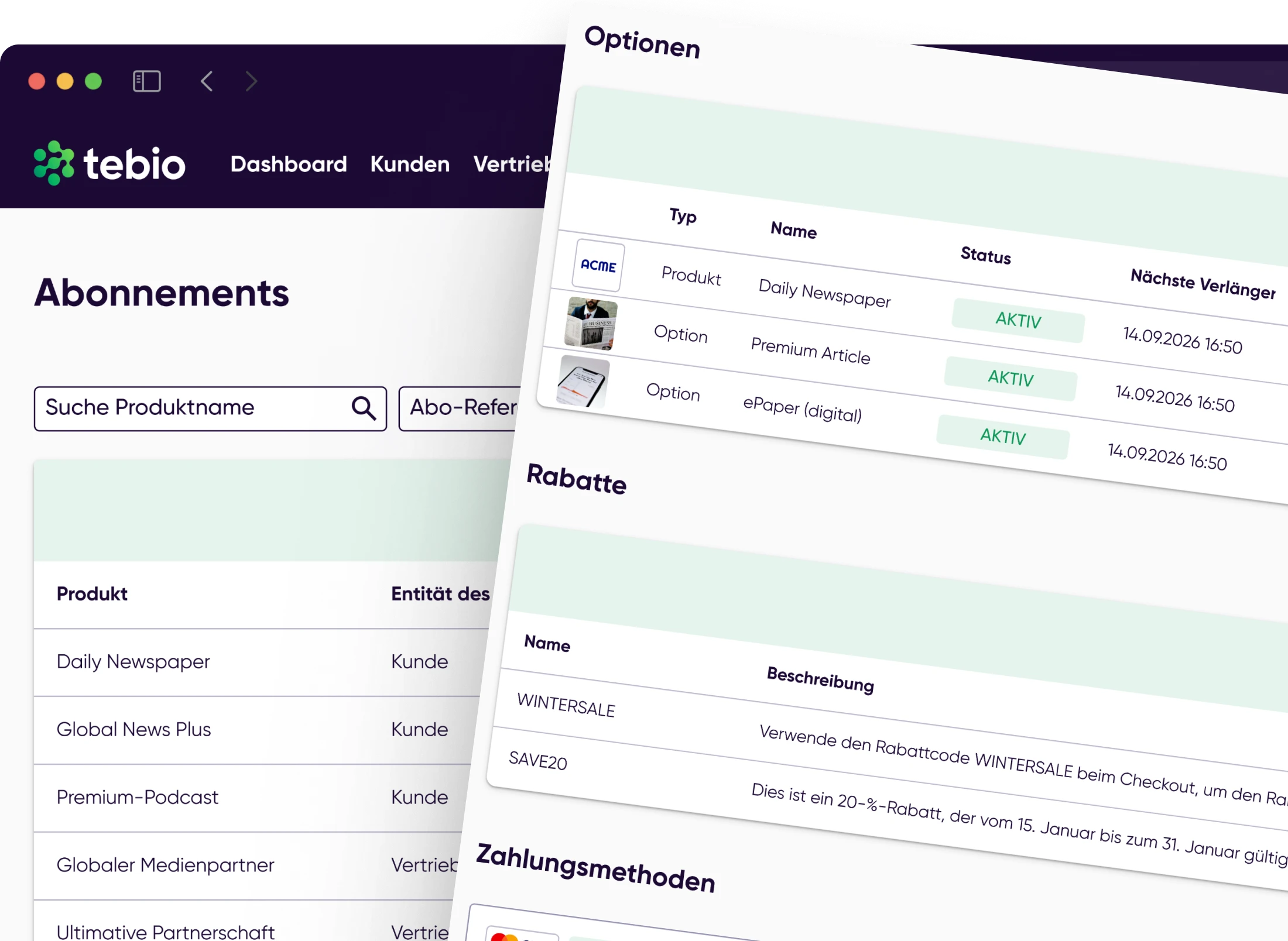
Manage customers, contacts, addresses, properties, subscriptions and event histories centrally in the Business Portal. This gives customer service, sales and Finance an overview of active plans and past changes.
Map mobile plans, data packages, add-on options, promotional prices and discounts using products, options and pricing logic.
tebio supports business models in which services are billed in advance or afterwards. This prepaid/postpaid logic is the commercial layer. For network real-time charging, balance management or usage control, additional OCS/network components can be integrated.
Usage events can flow into billing. This lets you account for mobile usage, consumed units, additional usage and usage-based line items in billing.
Included data, minutes, SMS, data packages or shared allowances can be taken into account as part of the plan model. Overages can be billed as additional usage.
Mobile service providers can handle payment processes such as SEPA direct debit and bank transfer via their own bank account. Incoming payments, open items and failed payments remain traceable in the Business Portal.
Customers can use digital Self-Care processes. Resulting requests can be handled, documented and linked to the customer context in the integrated helpdesk.
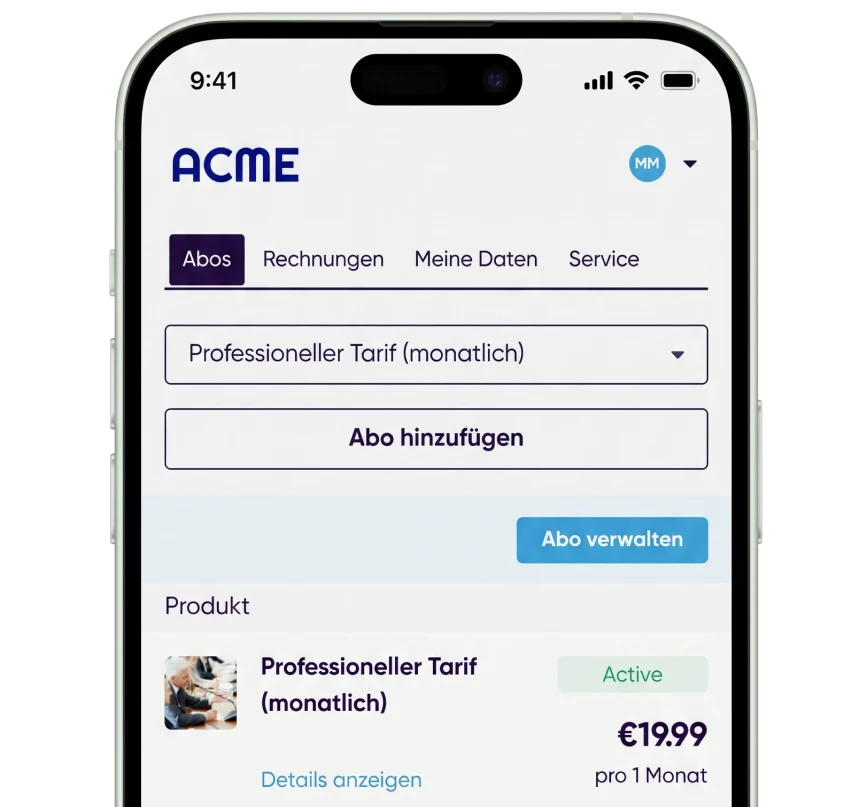
Connect tebio to external provisioning, SIM/eSIM, CRM, ERP, finance or data warehouse systems. API and Webhooks ensure that relevant subscription, plan, payment and billing events can be processed further.
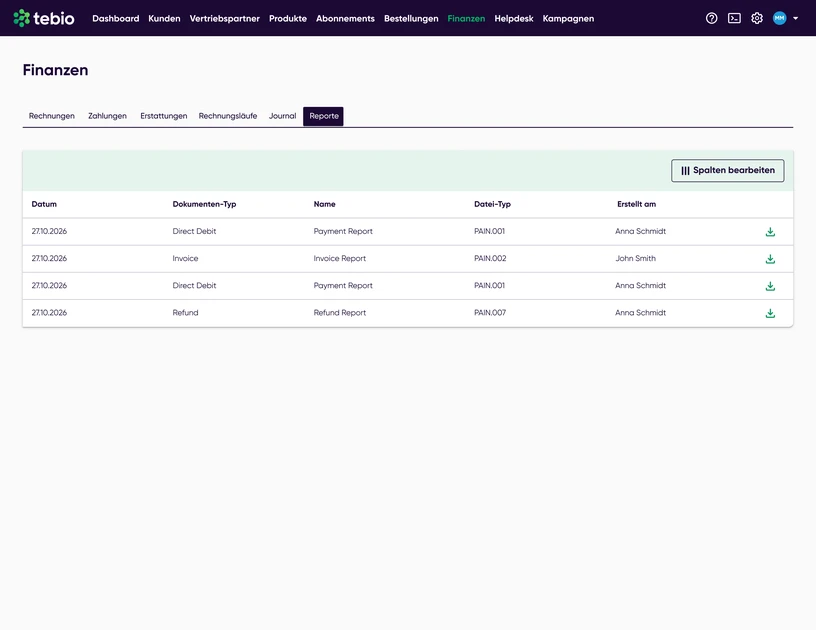
tebio supports invoices, receipts, journal, financial reports and DATEV-ready processes. For suitable B2B scenarios, e-invoices can also be relevant.
Mobile plans often combine base fees, options, included allowances and usage-based billing. tebio supports the commercial processing of usage events, recurring fees, discounts, proration, invoices and payment processes.
 Recurring base fees
 Plan options and add-on packages
 Prepaid and postpaid
 Usage-based billing
 Included allowances
 Exceeding usage
 Discounts
 Proration
 Billrun
 Invoices and receipts
 Payment statusOpen items
When usage should not only be billed afterwards, but already authorized, limited or controlled during an active network session, the telco solution can be extended with real-time charging and policy control.
An OCS can extend prepaid and postpaid scenarios with network-side real-time functions — for example balance management, quota control, hard usage limits or spending control.
 Real-Time Credit ControlBalance ManagementUsage LimitsSpending ControlPrepaid & Postpaid
Policy control can steer tariff- or usage-dependent rules in the network — for example bandwidth limits or quality-of-service rules.
Policy RulesBandwidth ControlQoSUsage-based PoliciesOCS and policy control are optional telco service components and not native tebio core modules. The actual feature set depends on the network integration and the available interfaces.
 Self-Care
 Event-based messages
 Helpdesk
tebio supports digital customer processes along the mobile contract lifecycle. Event-based messages, Self-Care features and integrated helpdesk processes help you handle customer requests in a structured, traceable way.
tebio can be connected to existing telco, provisioning, CRM, ERP, Finance and Self-Care systems via API and Webhooks. For broader telco-as-a-service projects, additional network-facing service components can be connected to the hosting network via standardized or project-specific interfaces.
 Sales frontendSelf-Care portalProvisioning systemSIM/eSIM systemCRMERPFinance systemData warehouseCustomer support systemPartner or reseller systemsReporting and BI systemsProvisioning / ActivationEvent-based Charging InputResource / Inventory Exchange




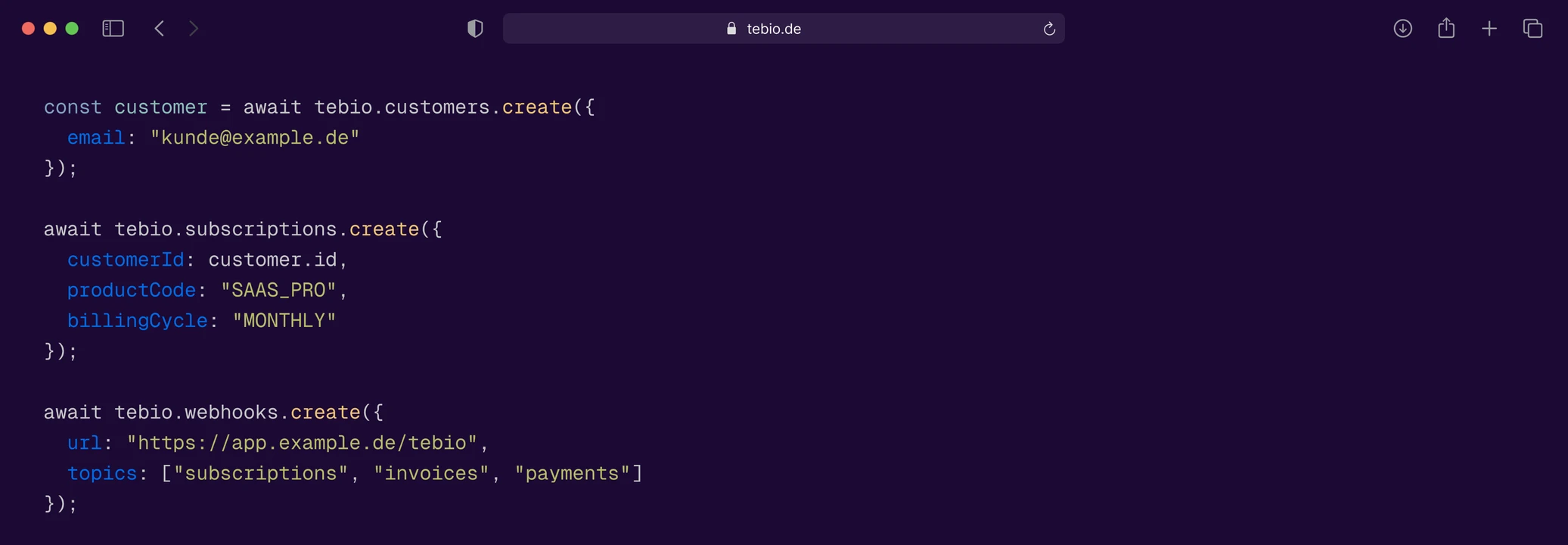
const customer = await tebio.customers.create({
  email: "kunde@example.de"
});

await tebio.subscriptions.create({
  customerId: customer.id,
  productCode: "MOBILE_20GB",
  billingCycle: "MONTHLY"
});

await tebio.webhooks.create({
  url: "https://app.example.de/tebio",
  topics: ["subscriptions", "invoices", "payments"]
});
Depending on the telco service component in use and the hosting network, standardized telecommunications interfaces can be used for charging, policy control or voice services.
Diameter Gy / Ro
Real-Time Credit ControlQuota / Session ControlDiameter Gx
Policy ControlSS7 CAP / CAMEL
Legacy 2G/3G Voice Control where requiredSIP / SIP-I
Signalling / InterconnectionRTP / SRTP
Voice mediaSS7
Legacy integration where requiredDepending on the service-provider model, the overall solution can additionally be extended with voice and value-added-service components.
For interconnect scenarios, a Class-4 voice platform can be integrated for routing, switching and secure SIP-based connections.
Class 4Call Routing & SwitchingI-SBCSIP / SIP-ITLS / SRTPscalable / geo-redundant architecturesClass-5 functions can complement business and residential voice scenarios such as Centrex/UCaaS or convergent fixed/mobile services.
Class 5Centrex / UCaaSFixed & Mobile VoiceRemote WorkingValue added services can provide additional voice, messaging and customer-service functions depending on the project.
IVRACDCall RecordingMessagingadditional service functionsThe voice and VAS components shown are optional parts of an extended telco solution and not part of the tebio core BSS.
Multi-client capability and network integration enable different service-provider and hosting models. This lets the architecture adapt to a single provider, multiple networks or multi-provider scenarios.

One service provider on one hosting network.
One service provider uses several hosting networks.
Suitable e.g. for different countries or network partners.

Several service providers run on a shared platform with one or more hosting networks.
The concrete architecture and isolation of providers and networks is defined per project.
The tebio documentation shows step by step how to set up products, prices, subscriptions, usage-based billing, invoices, payments, Hosted Pages and integrations.
 View documentation
 Create a subscription optionModel plan options, add-ons and additional services.Define pricesSet prices, fees and billing logic for your mobile offerings.Usage-based billingUnderstand how usage-based billing works in tebio.Billing logicUnderstand rating, billrun, invoices, payments and downstream processes.Prepaid vs. postpaidLearn the differences between prepayment and billing in arrears.Failed paymentsLearn how payment failures, open items and downstream processes are handled.Understanding WebhooksConnect tebio to external systems and react to events.Integration & APIConnect tebio to provisioning, Self-Care and other external systems.
Yes. tebio can map mobile plans, options, prices, discounts and terms using products and subscriptions. This lets you manage different plan models in a structured way.
Yes. Usage events can flow into billing. This lets you account for consumed units, additional usage and usage-based line items in billing.
Yes. Included data, minutes, SMS, data packages or shared allowances can be taken into account as part of the plan model. If an allowance is exceeded, additional usage can be billed as exceeding usage.
Yes. tebio can support billing models in which services are billed in advance or in arrears. The specific setup depends on the respective product and billing model.
Yes. External provisioning, SIM/eSIM or telco systems can be connected via API or Webhooks to process relevant subscription, plan, option or payment events.
Yes. tebio supports payment processes such as SEPA direct debit and bank transfer via the company's own bank account, provided they are configured accordingly. Incoming payments, open items and failed payments can be tracked in the Business Portal.
Yes. tebio supports digital Self-Care processes and integrated helpdesk features. Depending on the setup, customer requests can originate digitally and be handled further in the Business Portal.
No. tebio is a subscription management & billing platform. Network, provisioning or SIM/eSIM systems can be connected via API and Webhooks.
No. tebio is the BSS and commercial layer for customers, plans, subscriptions, usage, billing, payments and customer processes. For real-time charging or policy control, additional OCS/policy components can be integrated as part of an extended telco solution.
Yes. Depending on the functions and interfaces available from the hosting network, tebio can be connected to provisioning, resource/inventory and other telco processes. Additional telco service components can be used for network-facing functions.
Those telco protocols are not part of the regular tebio API. In extended telco-as-a-service projects, however, service components can be integrated that use, for example, Diameter Gy/Ro/Gx, CAMEL, SIP/SIP-I or RTP/SRTP to communicate with the hosting network.
Yes. Depending on the target architecture, 1:n scenarios are also possible, in which a service provider is connected to several hosting networks through a shared BSS/service solution.
Yes. Multi-client and network integration can also be combined for n:m scenarios. The concrete tenant, network and process isolation is defined per project.

Talk to us about your plans, subscription and billing processes and about integration with provisioning, real-time charging, voice services or existing hosting networks.